Design
How the enhanced shared bus is wired: who owns what, how events move, and what the publish / Subscriber contracts look like.
Ownership
Lab owns the bus and the RAM share. Dev owns the Subscriber and everything downstream of it. Management account is out of scope — share is lab → dev only.
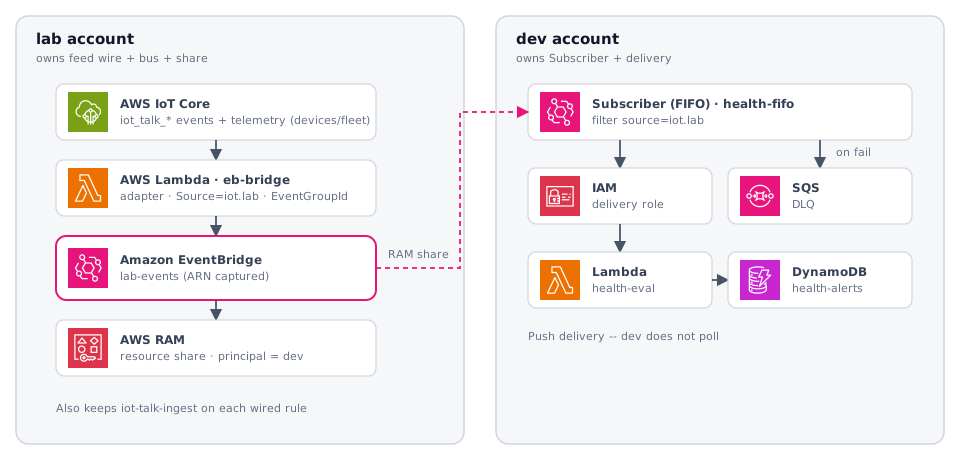
Official AWS Architecture Icons. Dashed magenta = AWS RAM. lab wires IoT Core → eb-bridge → lab-events. Bus ARN is captured at create into out/lab/bus-arn.txt — never invent it.
| Concern | Account |
|---|---|
| Enhanced bus + retention | lab |
| RAM resource share (principal = dev) | lab |
Publisher (IoT → eb-bridge → put-events) |
lab |
| Subscriber + delivery role + DLQ | dev |
| Proof of delivery (target + store) | dev |
Why eb-bridge exists
IoT topic-rule actions cannot call eventsv2 PutEvents on an enhanced bus
(event-busv2/...) with SystemMetadata.EventGroupId. The bridge Lambda is
the required adapter — not an optional workaround:
devices|fleet/+/events|telemetry → iot_talk_* rules → eb-bridge → lab-events
(Live traffic is mostly telemetry; events rules are wired the same way. Camera stays off the bus.)
It stamps Source=iot.lab (Subscriber filter) and EventGroupId=device_id
(FIFO). Each wired rule still invokes iot-talk-ingest; talk tables stay
untouched. CLI put-events in Verify is only a no-device smoke of the same
envelope.
The health-alert target is illustrative. Any Subscriber target works the same way.
Consume path
Dev does not poll the bus. EventBridge pushes through the Subscriber.
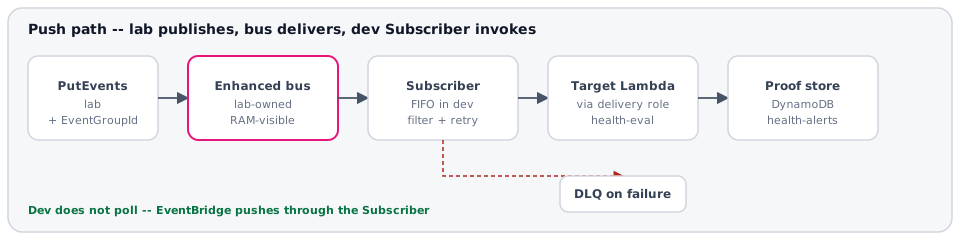
Proof that the feature works is a successful invoke in dev (this lab: a row in health-alerts). A publisher UI in lab only proves the feed.
Publish and FIFO
This lab’s publish contract (what eb-bridge and Verify stamp):
| Field | Role | Lab value |
|---|---|---|
EventBusArn |
Target bus | From out/lab/bus-arn.txt |
Source / DetailType / Detail |
Envelope | iot.lab / connectivity or button / JSON |
SystemMetadata.EventGroupId |
FIFO key | Entity id (device_id for this feed) |
FIFO Subscribers deliver one EventGroupId in order; different groups stay
independent and can proceed in parallel.
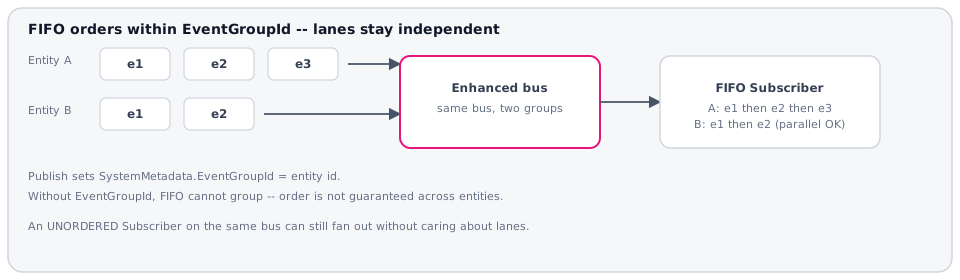
Lab uses FIFO so health-alert state converges. Comparison of FIFO vs UNORDERED (same bus): Patterns.
Subscriber settings
Dev owns the Subscriber, including the filter. Attach to the shared bus, select events, deliver locally — no bus-owner rule ticket.
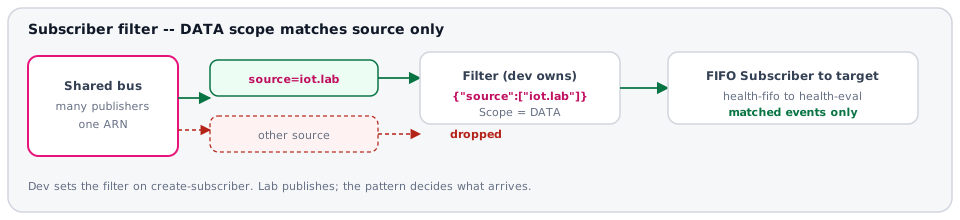
Scope=DATA · {"source":["iot.lab"]} · written to out/dev/filter.json in Deploy dev.
| Setting | Lab choice | Why |
|---|---|---|
--type |
FIFO |
Prove OPEN → CLEAR order for one entity (why not UNORDERED) |
--event-bus-arn |
Shared enhanced bus | Same ARN lab captured at create |
--starting-position |
LATEST |
Demo does not backfill retention |
--filter-configuration |
source = iot.lab (DATA) |
Dev selects; Verify must publish that Source. Wider filter → more egress (Cost) |
| Invoke | health-eval via delivery role |
Concrete target; swap freely |
| On failure | SQS DLQ | Capture poison / invoke failures |
Lab consumer (illustrative)
health-eval turns connectivity payloads into OPEN / CLEAR rows so verify has
something to read. Thresholds are demo-only:
| Condition | status |
reason |
|---|---|---|
rssi < -80 |
OPEN |
weak_rssi |
chip_temp_c > 55 |
OPEN |
high_temp |
heap_free < 100000 |
OPEN |
low_heap |
DetailType=button |
OPEN |
attention_button |
| none of the above (connectivity) | CLEAR |
healthy |
Extra guard: ignore events whose ts is older than the stored
source_event_ts for that entity (stale replay).
Naming and tags
Tag everything Project=eb-enhanced-bus. Region: ap-southeast-2.
| Resource | Name |
|---|---|
| Bus | lab-events |
| Bridge Lambda / role | eb-bridge / eb-bridge-role (IoT → bus) |
| RAM share | eb-enhanced-bus-share |
| Subscriber | health-fifo |
| Eval Lambda | health-eval |
| Table / DLQ | health-alerts / health-alerts-dlq |
Next: Cost for hop vs ingress/egress economics, then Demo to deploy and verify.